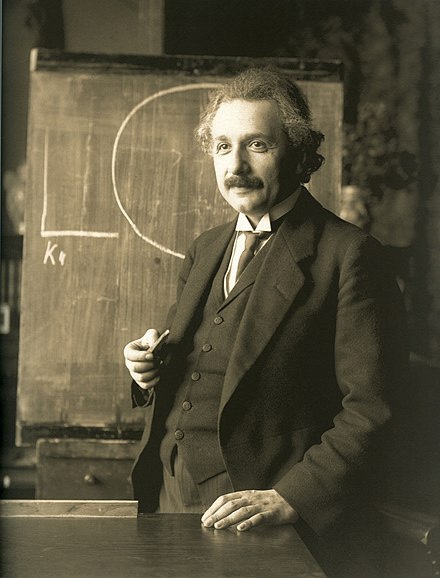
Albert Einstein (1879-1955) was a German-born theoretical physicist who is widely regarded as one of the most influential scientists of the 20th century. He developed the theory of relativity, which fundamentally changed the understanding of space and time, and made groundbreaking contributions to the study of quantum mechanics and statistical mechanics.
Einstein was born in Ulm, Germany, and showed an early interest in mathematics and physics. He attended the Swiss Federal Polytechnic School in Zurich and obtained his diploma in 1900. In 1905, Einstein published a series of papers that laid the foundations for modern physics, including the special theory of relativity, which introduced the concept of the speed of light being constant and the relationship between energy and mass (E=mc²).
In 1915, Einstein published his general theory of relativity, which proposed that gravity is not a force between masses, but rather a curvature of space-time caused by the presence of mass and energy. This theory revolutionized the understanding of gravity and the universe as a whole.
During the 1920s and 1930s, Einstein worked on developing a unified field theory that would unify the forces of nature, but this effort was ultimately unsuccessful. He also made significant contributions to the development of quantum mechanics, and was one of the founders of the Copenhagen interpretation, which sought to explain the paradoxes inherent in quantum mechanics.
Einstein was a vocal pacifist and advocate for civil rights, and was offered the presidency of Israel in 1952, which he declined. He continued to work on physics until his death in 1955, and his work continues to influence scientific research to this day.


 CelebSpotlights™
Leave a comment