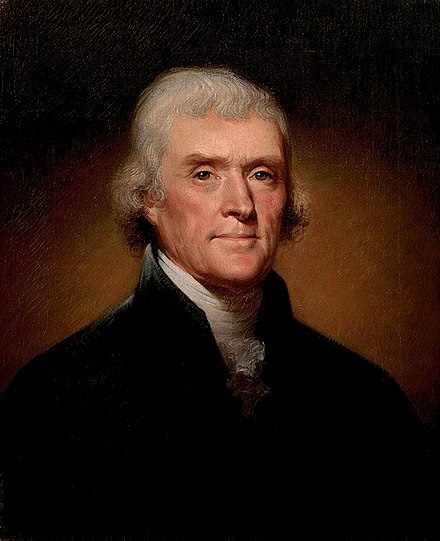
Thomas Jefferson (1743-1826) was an American statesman, diplomat, lawyer, and Founding Father who served as the third President of the United States from 1801 to 1809. He is perhaps best known for his role in writing the Declaration of Independence, which declared the American colonies’ independence from Great Britain in 1776.
Jefferson was born in Shadwell, Virginia, and grew up on his family’s plantation, where he was educated by private tutors. He attended the College of William and Mary, where he studied law and became involved in politics. In 1772, he married Martha Wayles Skelton, with whom he had six children (only two survived to adulthood).
In 1775, Jefferson was elected to the Virginia House of Burgesses, where he played an active role in the American Revolution. In 1776, he was appointed to the committee charged with drafting the Declaration of Independence, and he is credited with writing much of the document. After serving as governor of Virginia from 1779 to 1781, he was appointed as a delegate to the Continental Congress and later as Minister to France, where he served from 1785 to 1789.
Jefferson returned to the United States in 1789 and was appointed as the first Secretary of State by President George Washington. He resigned from this position in 1793 and returned to his home in Virginia, where he served as Vice President under John Adams from 1797 to 1801.
In 1800, Jefferson was elected President of the United States in a highly contentious election against Adams. During his presidency, he oversaw the Louisiana Purchase, which doubled the size of the United States, and he also commissioned the Lewis and Clark expedition to explore the western territories.
Jefferson retired from politics in 1809 and spent his remaining years at his home in Virginia, where he continued to be involved in the intellectual life of the country. He died on July 4, 1826, exactly 50 years after the signing of the Declaration of Independence. Jefferson is remembered as one of the most influential figures in American history, and his ideas about democracy, liberty, and individual rights continue to shape American political thought today.
 CelebSpotlights™
Leave a comment