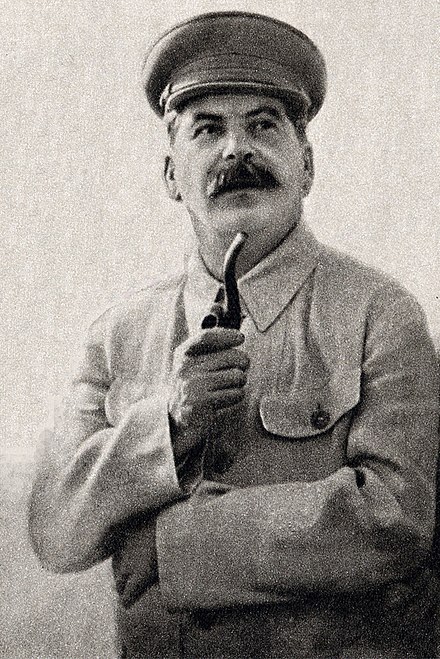
Joseph Stalin was a Soviet politician and revolutionary who served as the General Secretary of the Communist Party of the Soviet Union from 1922 until his death in 1953. He was born in Georgia in 1878 and joined the Bolshevik Party in 1903, becoming a close ally of Vladimir Lenin.
After the Bolsheviks seized power in Russia in 1917, Stalin rose through the ranks of the Communist Party and became one of the most powerful figures in the Soviet government. He served as the People’s Commissar for Nationalities from 1917 to 1922, and as the General Secretary of the Communist Party from 1922 onwards.
Under Stalin’s leadership, the Soviet Union underwent a rapid process of industrialization and collectivization, which saw the government seize control of private property and force peasants to work on state-owned farms. This policy led to widespread famine and hardship in rural areas, and millions of people died as a result.
Stalin also oversaw a brutal regime of repression and political purges, which saw thousands of people executed or sent to labor camps known as Gulags. The purges targeted political opponents, intellectuals, and ordinary citizens who were perceived as a threat to Stalin’s rule.
Despite his authoritarian methods, Stalin is credited with modernizing the Soviet Union and transforming it into a global superpower. His leadership during World War II helped to defeat Nazi Germany, and his policies laid the groundwork for many of the Soviet Union’s achievements in science, technology, and space exploration.
Stalin died in 1953, and his legacy remains a subject of debate and controversy. While some see him as a strong leader who modernized the Soviet Union and led it to victory in the war, others condemn him for the brutal tactics he employed to maintain his power and control over the Soviet people.
 CelebSpotlights™
Leave a comment